The Kasba border is no longer merely a geographical boundary; it has evolved into a theoretical laboratory of institutional decay and unaccountable governance. The chasm between Member of Parliament Mushfiqur Rahman’s reassuring narrative of a “Safe Kasba” and the harsh ground reality is not just an administrative discrepancy—it is a definitive manifestation of the gagging of the media (the Fourth Estate) and a deep-seated culture of impunity. The brutal murder of a content creator and the subsequent orchestrated digital cover-up suggest that Kasba has become a “Captured Town,” where syndicate interests supersede the rule of law.
1. The Deen Islam Homicide: Chronicle of a Death Foretold
On March 24, 2026, when an armed group of 20–30 individuals abducted Deen Islam from his home in Shimrail village, Mehari Union, it was not merely an act of “mob justice.” It was the culmination of long-term vendetta. Deen Islam paid the ultimate price for the investigations he conducted into local drug syndicates and corruption through his page, Talash Crime Drishti.
Strategic Analysis of the Event:
- Disregarded Warnings: Two months prior to his death, Deen Islam went live on Facebook, identifying his potential killers and expressing fear of abduction and murder. By ignoring this public threat to life, the state and local administration effectively granted the perpetrators a tacit “license to kill.”
- Operational Precision: The organized daytime assault and the subsequent dumping of the victim in a critical condition across the Buri River in Cumilla district served as a message designed to instill terror among local journalists and activists.
- Administrative Inertia: According to family allegations, the killers are shielded by political patronage. Local law enforcement appeared more invested in highlighting the victim’s prior legal record than in apprehending the suspects, undermining the neutrality of the investigation from the outset.
2. Digital Forensic Analysis: A 6-Minute Coordinated Propaganda
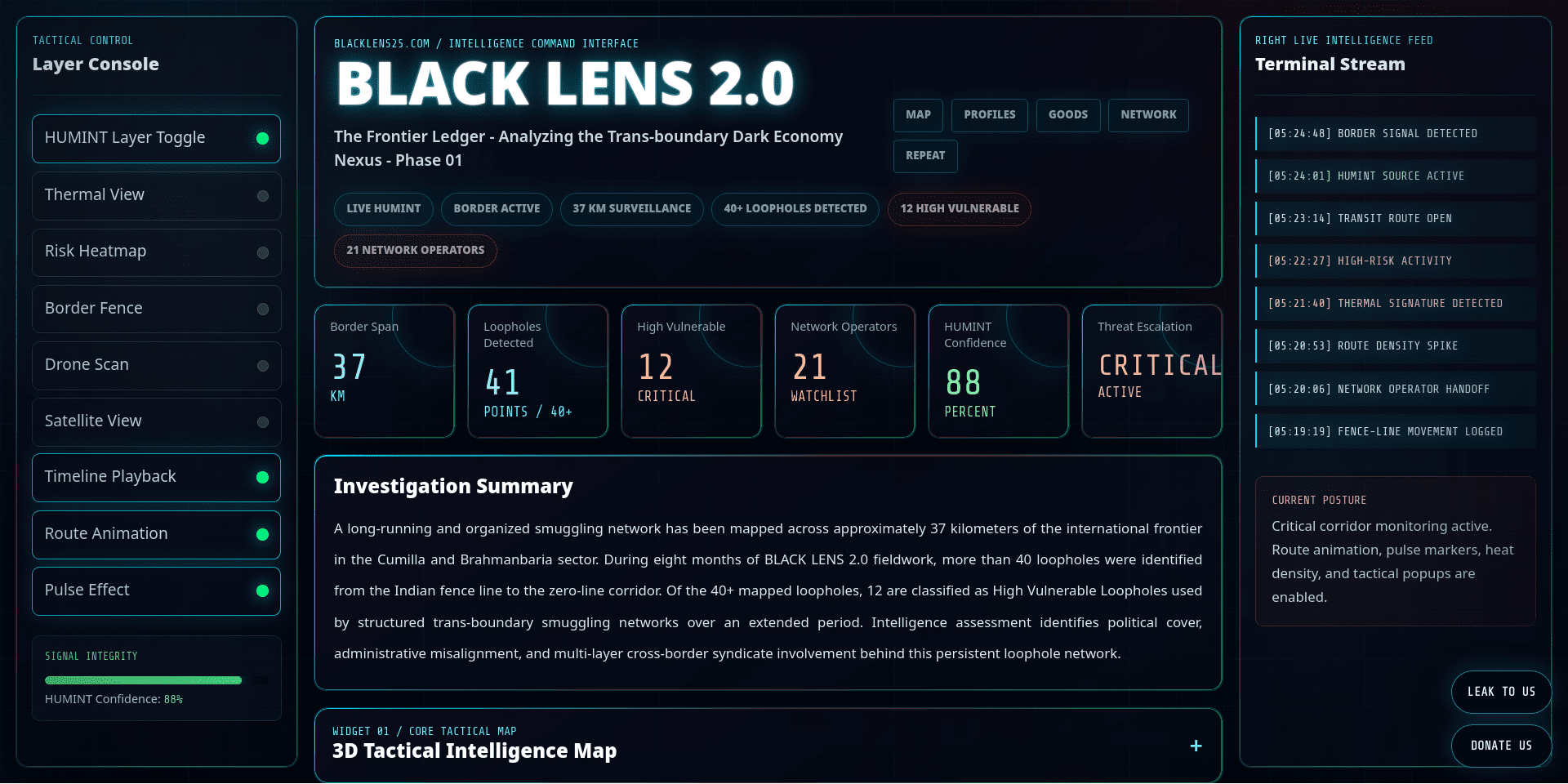
Forensic data from Black Lens 2.0 provides irrefutable evidence of how disinformation is weaponized to protect offenders. Analysis of the digital footprint reveals that while the physical homicide was occurring, a parallel “character assassination” or cover-up mission was being executed in the digital space.
Forensic Timeline of the Digital Footprint:
- Exhibit A (The 1-Minute Mark): An individual identified as MD Sirajul Haque Imo posted labeling Deen Islam as a “fake journalist” and a “robber.” Forensic analysis shows a screenshot of this post was taken just one minute (“1m”) after publication.
- Key Forensic Indicator: The User Interface (UI) element “Comment as MD Sirajul Haque…” is visible at the bottom of the screenshot. This confirms the screenshot was taken by Imo himself from his logged-in device, establishing an unbreakable Chain of Custody.
- The 6-Minute Coordination: Exactly six minutes after Imo’s post, Jahangir Alam—the Mehari UP Panel Chairman and the 4th accused in the murder case—shared the same screenshot and a curated criminal list on his timeline.
- Inference: This real-time transmission and the synchronized narrative within a six-minute window prove this was not an isolated post but a Coordinated Information Operation (CIO) designed to reframe the murder as a dispute over “stolen loot.”
3. Parliamentary Narrative vs. Ground Reality
While MP Mushfiqur Rahman possesses vast administrative experience as a former Government Secretary and World Bank Alternative Executive Director, his recent assessment of Kasba conflicts sharply with empirical data. This “strategic obfuscation” serves as a shield against administrative accountability.
Comparative Analysis Table:
| MP’s Assertion (Interview) | Fact-Based Reality (Field Data) |
|---|---|
| Kasba is safe; law and order are normal. | Four political homicides have occurred in Kasba in the last four months. |
| Anti-drug drives are netting the “big fish.” | While “linemen” like Nuru are caught, syndicate kingpins like “Goru Daktar Saro” (Sarowar Alam) remain untouched. |
| Freedom of the press is fully upheld. | Investigative creators like Deen Islam face lynching for uncovering the truth. |
| Mob violence does not exist. | The group-led killing of Deen Islam is a definitive example of brutal mob violence. |
4. The Kasba Corridor: Institutional Capture and High-Level Involvement
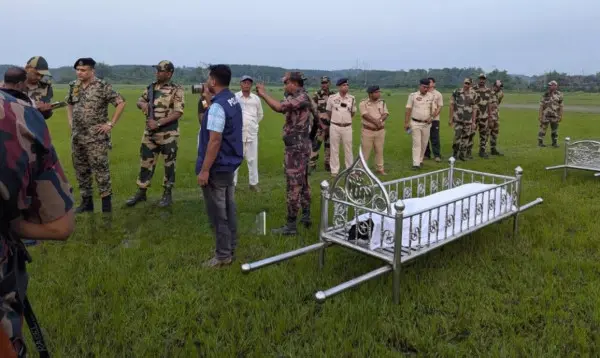
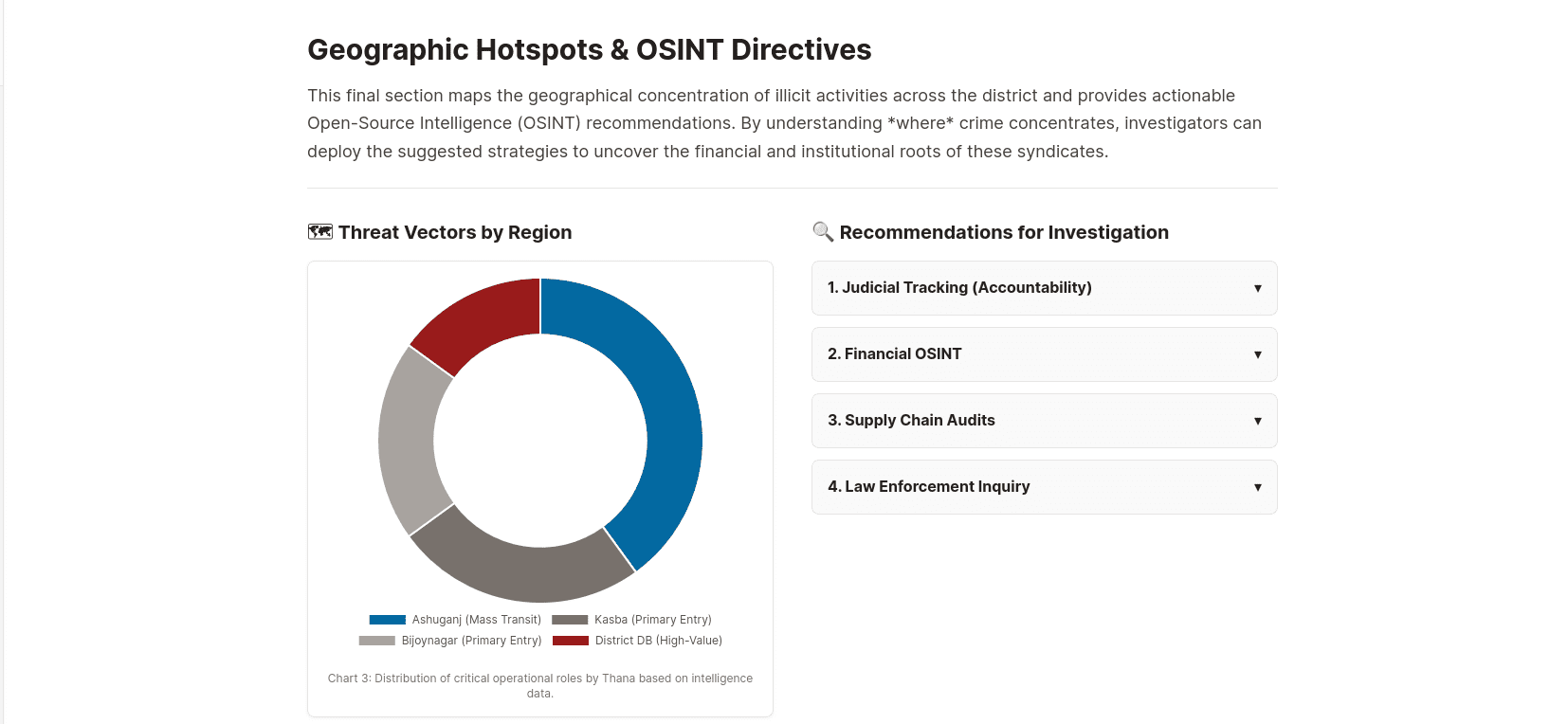
An intelligence dossier titled “Project Kasba: The Cold Trail” describes the Kasba border as a “sieve.” It is no longer a route for petty smuggling but a Tier-1 security risk to national sovereignty.
Strategic Risks of the Kasba Border:
- Auric Transit: Smuggled gold moves through this corridor to balance trans-border Hundi Ledgers, serving as a primary liquidity route for the shadow economy.
- Ghost Cashing: For smuggling high-end optics and smartphones, syndicates utilize “ghost caching”—burying goods underground to evade surveillance—a method far more sophisticated than traditional agricultural smuggling.
- Military-Grade Ordnance: Most alarming are reports of Heavy Kinetic Armaments moving through this corridor. The dossier suggests that the free movement of such weaponry is impossible without the complicity of high-ranking administrative sentinels.
- Engineered Impunity: Allegations have surfaced that following the murder, instructions were purportedly issued to the DC, OC, and UNO to exercise “restraint” (avoiding Barabari). Consequently, the victim was processed as an unidentified body in the presence of police, bypassing immediate rescue efforts—a textbook case of engineered impunity.
5. Conclusion: The Accountability Crisis and Kasba’s Future
The situation in Kasba is not merely a regional crime story; it is a national security concern. When a state fails to protect a citizen despite a pre-recorded deathbed warning, and when digital forensics clearly link the killers to local leadership, administrative silence becomes synonymous with consent.
If high-level syndicates involved in “Ghost Cashing” and “Auric Transit” continue to operate under political protection, Kasba will not only remain a sanctuary for criminals but will become a permanent wound on the sovereignty of the state. Restoring public trust in the legal system requires transparent answers to the analytical questions raised by watchdogs like Black Lens 2.0.
Kasba awaits the truth.